

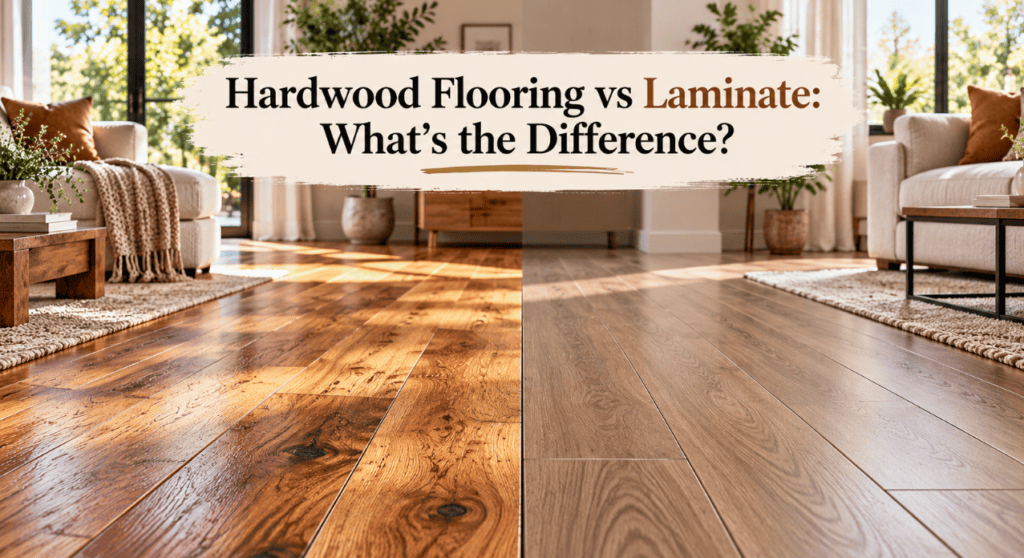
Hardwood Flooring vs Laminate: What’s the Difference?
The main difference between hardwood flooring and laminate is the material. Hardwood flooring is made from real wood, while laminate uses a photographic wood-look layer over a manufactured core.
Hardwood generally offers a more natural appearance, longer lifespan, greater repair potential, and stronger long-term value. Laminate is usually less expensive, more scratch-resistant, and easier to install.
So, which should you choose?
Choose hardwood flooring if you want genuine wood, long-term durability, the ability to refinish the surface, and a premium appearance. Choose laminate flooring if your priority is lower upfront cost, straightforward maintenance, and resistance to everyday scratches.
The right option depends on your budget, household traffic, moisture exposure, design preferences, and how long you expect the floor to remain in place.
This guide compares hardwood flooring vs laminate across the factors that matter most.
What Is Hardwood Flooring?
Hardwood flooring is made from real wood.
It is available mainly in two forms:
Solid Hardwood
Solid hardwood planks are made from a single piece of wood.
Common species include:
- Oak
- Maple
- Hickory
- Walnut
- Cherry
- Ash
Because the plank consists of real wood throughout, many solid hardwood floors can be sanded and refinished several times.
Engineered Hardwood
Engineered hardwood has a real hardwood surface layer bonded over multiple supporting layers.
It provides the appearance of genuine wood while offering greater dimensional stability than many solid hardwood products.
Depending on the thickness of its wear layer, engineered hardwood may also be refinished.
What Is Laminate Flooring?
Laminate flooring is a manufactured flooring product designed to imitate hardwood, stone, or other materials.
A typical laminate plank contains:
- A transparent protective wear layer
- A decorative photographic layer
- A high-density fiberboard core
- A stabilizing backing layer
The wood appearance comes from a printed image rather than actual wood grain.
Modern laminate can look highly realistic, but it is still fundamentally different from natural hardwood.
Hardwood vs Laminate at a Glance
Here is the simplest comparison.
Hardwood Flooring
Best for homeowners who want:
- Real wood
- Natural grain variation
- Long lifespan
- Refinishing options
- Premium appearance
- Stronger long-term value
Laminate Flooring
Best for homeowners who want:
- Lower initial cost
- Good scratch resistance
- Easy installation
- Simple maintenance
- A wood-look surface without paying for real hardwood
1. Appearance
Appearance is one of the biggest differences between hardwood and laminate.
Hardwood Appearance
Every hardwood plank is naturally unique.
Variations may appear in:
- Grain
- Knots
- Color
- Mineral streaks
- Texture
These natural differences give hardwood depth and character that printed flooring can be difficult to reproduce perfectly.
Hardwood can also change gradually over time as it ages and reacts to sunlight.
Laminate Appearance
Laminate uses high-resolution printed patterns to imitate real wood.
Premium laminate can reproduce:
- Oak
- Walnut
- Maple
- Hickory
- Reclaimed wood
- Wide-plank styles
Embossed textures can make the surface look and feel more realistic.
However, repeated print patterns may sometimes become noticeable across a large room.
Winner for natural appearance: Hardwood
2. Cost
Laminate is generally less expensive than hardwood.
Hardwood Cost
Hardwood usually has a higher material and installation cost.
The final price depends on:
- Wood species
- Plank width
- Grade
- Finish
- Solid vs engineered construction
- Subfloor preparation
- Installation method
Premium or rare wood species can increase the cost considerably.
Laminate Cost
Laminate is typically more budget-friendly.
Its lower material cost and click-lock installation system may also reduce installation expenses.
However, price should be considered alongside expected lifespan.
A floor that costs less initially but needs replacement sooner may not provide the best long-term value.
Winner for initial affordability: Laminate
3. Lifespan
Hardwood generally has a longer potential lifespan.
How Long Does Hardwood Last?
Well-maintained hardwood flooring can last for many decades.
Solid hardwood can sometimes remain in service for 50 to 100 years or longer when it is properly installed, maintained, and refinished when necessary.
Engineered hardwood lifespan varies according to its construction and wear-layer thickness.
How Long Does Laminate Last?
Laminate commonly has a shorter service life than hardwood.
Its lifespan depends on:
- Product quality
- Foot traffic
- Moisture exposure
- Installation
- Maintenance
Once the decorative surface becomes heavily worn or damaged, the plank normally needs replacement rather than refinishing.
Winner for lifespan: Hardwood
4. Scratch Resistance
Laminate can have an advantage in households concerned about surface scratches.
Hardwood
Real wood can develop scratches from:
- Pet nails
- Furniture
- Sand
- Grit
- High heels
- Heavy objects
The amount of visible damage depends on wood hardness and finish quality.
The advantage is that many hardwood floors can later be sanded and restored.
Laminate
Laminate has a durable transparent wear layer that often resists light scratches well.
This can make it suitable for:
- Busy families
- Pets
- High-traffic rooms
However, deep scratches that penetrate the decorative layer cannot normally be sanded away.
Winner for everyday scratch resistance: Laminate
5. Water Resistance
Neither traditional hardwood nor standard laminate should be treated as completely immune to water.
Hardwood and Moisture
Too much moisture can cause hardwood to:
- Swell
- Cup
- Crown
- Buckle
- Stain
Spills should be cleaned quickly.
Engineered hardwood may handle humidity changes better than solid wood, but excessive water can still damage it.
Laminate and Moisture
Traditional laminate can swell when water reaches its fiberboard core.
Newer water-resistant or waterproof-rated laminate products provide improved protection against surface spills, but water can still cause problems if it reaches damaged seams or the subfloor.
Always check the manufacturer’s product specifications.
Winner: Depends on the specific product.
6. Maintenance
Both flooring types are relatively easy to maintain when cared for correctly.
Cleaning Hardwood
Hardwood should be:
- Swept regularly
- Vacuumed with a hard-floor setting
- Cleaned with minimal moisture
- Wiped immediately after spills
- Cleaned with hardwood-safe products
Avoid steam mops and soaking-wet cleaning.
Cleaning Laminate
Laminate also benefits from:
- Regular sweeping
- Vacuuming
- Light damp-mopping
- Immediate spill cleanup
- Manufacturer-approved cleaners
Avoid allowing large quantities of water to remain between planks.
Neither floor should require aggressive scrubbing.
Winner for maintenance: Roughly equal
7. Repair Options
Hardwood offers greater restoration potential.
Repairing Hardwood
Depending on the damage, hardwood may be:
- Recoated
- Sanded
- Refinished
- Stained
- Repaired by replacing individual boards
Scratches and surface wear do not always mean the floor needs to be replaced.
Repairing Laminate
Individual laminate planks can often be replaced.
However, laminate cannot normally be sanded and refinished because doing so would remove the printed decorative layer.
Severe scratches, chips, swelling, or worn patterns generally require plank replacement.
Winner for repairability: Hardwood
8. Refinishing
This is one of hardwood’s biggest advantages.
Solid hardwood can often be refinished multiple times, depending on board thickness and previous sanding.
Some engineered hardwood floors can also be refinished when the real wood wear layer is thick enough.
Laminate cannot be refinished in the same way.
If the laminate surface becomes worn through, replacement is usually the practical solution.
Winner: Hardwood
9. Installation
Laminate is generally easier to install.
Hardwood Installation
Hardwood installation may involve:
- Nailing
- Stapling
- Gluing
- Floating installation for some engineered products
The process may also require:
- Acclimation
- Moisture testing
- Subfloor preparation
- Expansion spacing
Professional installation can help protect the long-term stability of the floor.
Laminate Installation
Most laminate uses a click-lock floating system.
The boards connect to each other without being directly fastened to the subfloor.
This can make installation faster.
However, the subfloor must still be flat, clean, dry, and properly prepared.
Winner for installation simplicity: Laminate
10. Comfort and Feel
Hardwood often feels more substantial and natural underfoot.
Real wood has a warmth and character that many homeowners prefer.
Laminate can feel harder or more hollow, especially when installed as a floating floor over certain underlayments.
Higher-quality underlayment can improve sound and comfort.
Winner for natural feel: Hardwood
11. Sound
Hardwood that is properly installed can provide a solid feel underfoot.
Floating laminate may sometimes create:
- Clicking
- Hollow sounds
- Footfall noise
The effect depends heavily on subfloor quality and underlayment.
Premium acoustic underlay can improve laminate performance.
12. Resale Appeal
Hardwood is generally regarded as the more premium flooring material.
Because it is made from real wood and may last for decades, buyers often see hardwood as a desirable feature.
Laminate can still improve a home’s appearance, especially when replacing damaged or outdated flooring, but it generally does not carry the same perception as genuine hardwood.
Actual resale impact varies by property and local real estate market.
Winner for premium appeal: Hardwood
13. Which Is Better for Pets?
Both options have advantages.
Hardwood With Pets
Hardwood provides natural beauty and long-term repair potential.
However, pet nails may scratch the finish.
You can reduce damage by:
- Trimming nails
- Using rugs
- Cleaning grit regularly
- Applying furniture protection
Laminate With Pets
Laminate’s wear layer often handles light scratches well.
It may therefore be practical for homes with active dogs.
However, pet accidents should be cleaned quickly to prevent liquid from entering seams.
If deep surface damage occurs, refinishing is not an option.
14. Which Is Better for High-Traffic Areas?
High-quality laminate can perform well in busy rooms because of its scratch-resistant wear layer.
Hardwood can also work well, particularly when a durable finish and appropriate wood species are chosen.
The difference is what happens after years of wear.
Hardwood can often be restored.
Laminate will eventually require replacement when its decorative surface becomes heavily damaged.
15. Which Is Better for Bedrooms?
Both are good options.
Laminate may be appealing when budget is important.
Hardwood may be preferred when homeowners want:
- Natural warmth
- Long lifespan
- Premium aesthetics
- Refinishing options
Area rugs can add comfort to either flooring type.
16. Which Is Better for Living Rooms?
Hardwood is often an excellent choice for living rooms because these spaces usually play a major role in the overall appearance of the home.
Real wood can complement a wide range of interior styles.
Laminate can provide a similar visual effect at a lower initial cost.
Choose based on budget and how long you expect to keep the flooring.
17. Which Is Better for Kitchens?
Both require careful product selection in kitchens because spills are common.
Engineered hardwood may be suitable when the flooring manufacturer approves kitchen installation.
Water-resistant laminate can also work well.
Whatever you select:
- Clean spills immediately.
- Protect areas around sinks.
- Inspect appliance connections.
- Do not leave standing water on the floor.
Hardwood Flooring Pros and Cons
Advantages
Hardwood offers:
- Genuine wood appearance
- Unique natural grain
- Long lifespan
- Refinishing potential
- Repair options
- Premium feel
- Strong design versatility
Disadvantages
Potential disadvantages include:
- Higher upfront cost
- More sensitivity to scratches
- Moisture sensitivity
- Professional installation often recommended
- Periodic refinishing may eventually be required
Laminate Flooring Pros and Cons
Advantages
Laminate offers:
- Lower initial cost
- Good scratch resistance
- Many design options
- Easy routine cleaning
- Fast installation
- Consistent appearance
Disadvantages
Potential disadvantages include:
- Cannot normally be refinished
- Shorter potential lifespan
- Water can damage the core
- Deep scratches may require plank replacement
- Does not provide genuine wood grain
Hardwood vs Laminate: Which Should You Choose?
Choose hardwood flooring when you prioritize:
- Authentic wood
- Long-term value
- Natural character
- Refinishing
- Repairability
- Decades of potential service
Choose laminate flooring when you prioritize:
- Lower upfront cost
- Scratch resistance
- Quick installation
- Easy maintenance
- Affordable wood-look designs
Think beyond the purchase price.
Consider how you expect the floor to perform over the next 10, 20, or even 30 years.
Why Professional Installation Matters
Even high-quality flooring can develop problems when installed over an unsuitable subfloor.
Professional preparation can include:
- Checking subfloor flatness
- Measuring moisture
- Repairing damaged areas
- Planning expansion space
- Selecting underlayment
- Choosing the appropriate installation method
If you are considering real wood, experienced hardwood floor installers can help evaluate your property and recommend a flooring system suitable for your room conditions, lifestyle, and design preferences.
Why Choose ElmWood Flooring?
ElmWood Flooring provides professional hardwood flooring installation, repair, restoration, and refinishing services.
Choosing between laminate and hardwood is not only about how the floor looks in a showroom. You also need to consider:
- Subfloor type
- Moisture conditions
- Household traffic
- Pets
- Room location
- Maintenance preferences
- Long-term plans
- Budget
- Desired appearance
ElmWood Flooring can help homeowners determine whether solid hardwood or engineered hardwood provides the right balance of appearance, durability, and long-term performance.
If you already have hardwood, ElmWood Flooring can also inspect the floor to determine whether restoration or refinishing may be more practical than covering or replacing it with another material.
Professional guidance can help you make a flooring decision based on long-term performance rather than purchase price alone.
Frequently Asked Questions
Is hardwood better than laminate?
Hardwood is generally better for homeowners who want real wood, long lifespan, refinishing options, and a premium appearance. Laminate may be better when affordability and scratch resistance are priorities.
Which lasts longer, hardwood or laminate?
Hardwood typically has the greater potential lifespan because many hardwood floors can be refinished instead of replaced.
Is laminate cheaper than hardwood?
Yes, laminate generally has a lower material and installation cost than genuine hardwood flooring.
Can laminate flooring look like real hardwood?
Yes. Modern laminate uses high-resolution printing and textured surfaces to imitate different wood species, although it does not contain a real hardwood surface.
Can laminate floors be refinished?
No. Sanding would remove the decorative layer. Damaged laminate planks usually need repair or replacement.
Can hardwood floors be refinished?
Yes. Most solid hardwood and some engineered hardwood floors can be refinished if enough usable wood remains.
Which is better for dogs, hardwood or laminate?
Laminate may provide greater resistance to light nail scratches, while hardwood offers better restoration options if scratches eventually occur.
Which floor adds more value to a home?
Hardwood is generally viewed as a more premium flooring material, although the effect on resale value depends on the home and local market.
Is laminate waterproof?
Some laminate products offer strong water resistance or are marketed for waterproof performance, but installation joints and the subfloor still need protection from moisture.
Is hardwood more difficult to maintain than laminate?
Not significantly. Both require regular sweeping, appropriate cleaners, and quick spill removal. Hardwood generally requires more attention to moisture and may eventually need recoating or refinishing.
Final Thoughts
The biggest difference between hardwood and laminate is simple: hardwood is genuine wood, while laminate is a manufactured product designed to reproduce the look of wood.
Laminate usually wins on upfront affordability, easy installation, and scratch resistance.
Hardwood offers natural beauty, a much longer potential service life, repairability, and the ability to refinish the surface rather than automatically replacing it when wear develops.
If you are planning flooring for a short-term renovation or working with a limited budget, laminate may be a practical choice.
If your goal is a premium floor that can remain part of the home for decades, hardwood may provide greater long-term value.
For professional hardwood installation, refinishing, repair, or advice on choosing the right wood flooring, ElmWood Flooring can evaluate your space and recommend an option suited to your home’s design and long-term needs.

