

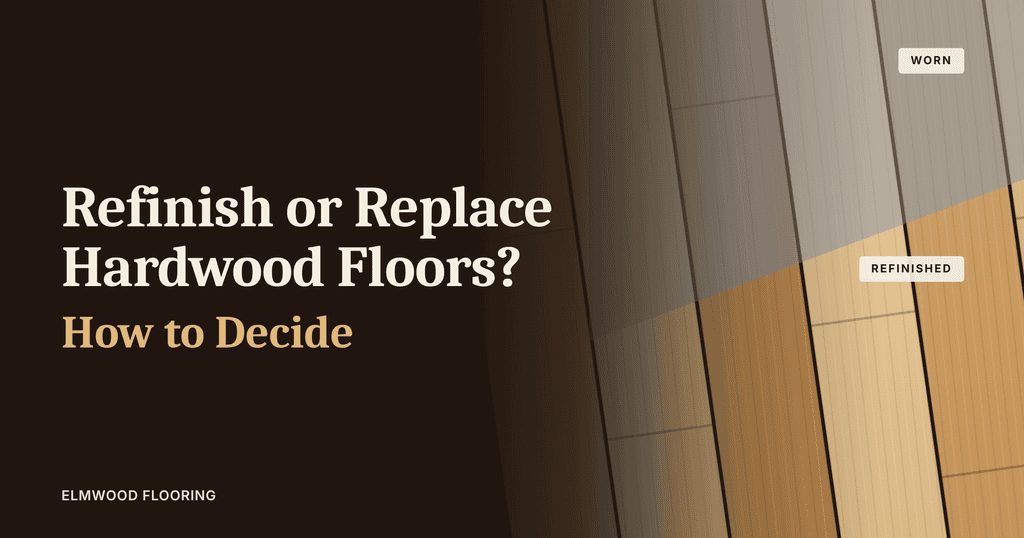
Most worn hardwood floors can be refinished rather than replaced. Refinishing is usually the right choice when the boards are structurally sound, firmly attached and still have enough wood above the tongue-and-groove joint to sand. Replacement makes more sense when boards are rotted, badly buckled, loose over a damaged subfloor, or already sanded too thin. Because some of these conditions are hidden, the most reliable answer comes from measuring the floor, not just looking at it.
Elmwood Flooring has provided hardwood floor refinishing and installation in Chicago since 1976, and “should we refinish or replace?” is one of the questions homeowners ask us most. This guide compares hardwood floor refinishing vs. replacement, walks through the signs that point each way, and explains what to check before you decide.
Refinishing vs. replacement at a glance
| Refinishing | Replacement | |
| What happens | Existing boards are repaired, sanded (or lightly abraded) and given new finish | Old flooring is removed, subfloor repaired if needed, new boards installed |
| Keeps original wood | Yes | No |
| Typical disruption | Usually days | Longer, especially if solid wood needs acclimation |
| Best for | Sound floors with surface wear, dullness, scratches or a dated color | Structural damage, rot, floors sanded too thin, or a change of species or width |
| Main limit | How much sandable wood remains | Material use and a longer project |
Not just two options: four levels of renewal
Most people frame it as “refinish or replace,” but there are really four levels, from lightest to heaviest:
- Screen and recoat. The old finish is lightly abraded and fresh coats are applied. No wood is removed. This works when wear is limited to the finish.
- Full sand and refinish. The floor is taken down to bare wood, then stained if wanted and finished. This is needed for scratches into the wood, wear patterns, dents, or a color change.
- Repair and refinish. Damaged boards are cut out and replaced with matching wood, then the whole floor is sanded and finished so the repair blends in.
- Replacement. The floor is removed and new flooring is installed.
Industry guidance generally holds that a recoat is often enough unless the floor has visible dents, wear into the wood, permanent cupping, or you want to change the color. Starting with the lightest option that solves the problem preserves wood for the future.
Signs refinishing will likely work
- Scratches stay in the finish. Run a fingernail across a scratch. If it does not catch, the damage is usually in the finish rather than the wood.
- Dull or gray traffic lanes. Gray areas often mean the finish has worn through and the wood has oxidized, which wood floor sanding usually removes.
- Light surface stains that have not soaked deep into the boards.
- A few damaged boards that can be replaced and blended in.
- You want a new color. Sanding to bare wood lets you change the stain completely.
- Enough wood remains above the tongue to sand safely (see below).
Signs you need to replace hardwood floors
- The floor has been sanded too thin. Exposed nail heads, visible tongues or splintering along board edges mean there is little or no sandable wood left.
- Soft or spongy spots. These usually point to subfloor or joist damage that refinishing cannot fix.
- Severe buckling or rot after a leak or flood.
- Deep, widespread pet or water stains across many boards, where replacing individual boards is no longer practical.
- It isn’t solid hardwood. Laminate and vinyl cannot be refinished. Engineered floors with a very thin veneer may not be sandable.
- You want something different, such as wider planks, a new species, or a floor better suited to a basement or concrete slab.
Many projects end up as a mix: the sound areas are refinished, and damaged sections are replaced and woven in.
How much wood is left? The technical part
There is no single number that applies to every floor, but these guidelines help.
Solid hardwood. A standard 3/4-inch solid floor usually has about 1/4 inch of wood above the tongue. A full sanding typically removes roughly 1/32 to 1/16 inch, depending on how flat the floor is, how deep the damage goes, the equipment and the skill of the crew. Industry sources commonly cite anywhere from about four to eight full sandings for solid floors under good conditions. Elmwood’s own rule of thumb for standard floors is about four to five. Floors that were sanded aggressively in the past, or that use thinner boards, will allow fewer.
How thin is too thin? Many flooring professionals become cautious at around 1/8 inch of wood above the tongue, because the groove edge can begin to splinter when sanded at that point. Some industry guidance sets the minimum sandable wear layer closer to 3/32 inch. Thickness also varies across a floor, so it should be measured in several places, such as at floor registers, thresholds or from an unfinished basement below.
Engineered hardwood. Only the top veneer can be sanded, and on some products the veneer is not as deep as the tongue. As a general guide, veneers under about 2 mm should not be sanded, only recoated. Thicker veneers may allow one or more careful sandings. The manufacturer’s specifications are the final word, so check them before any sanding.
Questions that settle the decision
- How long will you stay? If you are selling soon, refinishing original hardwood usually makes the strongest impression for the least disruption.
- Is the damage everywhere or in one area? Localized damage can usually be repaired. Widespread structural damage points to replacement.
- Do you want a different look? Refinishing can change color, but not board width, species or pattern.
- Has the floor had water problems? If boards are cupped, buckled or water-stained, find and fix the moisture source first. Sanding a cupped floor before it dries can leave the boards crowned once they flatten.
When replacement is the answer
If the floor cannot be saved, replacement is a chance to choose the right product for the space. New solid hardwood floors in the original species and width can be laced into the existing floor and refinished together, so an older home keeps its character. For basements and concrete slabs, engineered hardwood is usually the better choice because it is more stable over concrete and moisture. Elmwood’s flooring installation team handles removal, subfloor repair and installation.
How Elmwood Flooring helps you decide
Every project starts with a phone quote and an on-site inspection that includes moisture testing. During the inspection, the team checks the wood species, whether the floor is solid or engineered, how much wear layer remains, the current finish and how deep the damage goes. You get a written agreement that defines the scope of work, whether that is a recoat, a full refinish, repairs or replacement.
Refinishing work comes with a 12-month labor warranty and up to a 10-year finish warranty, in writing. Products Elmwood supplies also carry the manufacturer’s warranty, and exact terms depend on your contract. Elmwood’s crews are licensed, insured and bonded.
Not sure which way your floor leans? Contact Elmwood Flooring for a quote and an on-site assessment. If a recoat is all your floor needs, we’ll tell you.
Frequently asked questions
Should I refinish or replace my hardwood floors?
Elmwood recommends a professional assessment. A standard floor can usually be sanded four to five times before it needs replacing. Refinishing or repair is advisable when the finish is nearly gone, the floor looks very dirty, or bare wood is showing through.
How dusty is floor sanding?
Most Elmwood jobs achieve roughly 75% to 90% dust reduction. Higher levels of dust containment require a dust collector or indoor air filtration, which adds cost and is your choice. After sanding, replacing your air filters and having ducts cleaned annually are recommended.
How soon can I walk on my refinished floors?
As typical guidance, wait about 4 to 8 hours before walking on the floor, 24 to 48 hours before moving heavy items back, and about 5 to 7 days for the finish to fully cure. Oil-based finishes can take considerably longer to cure. Humidity affects all of these times, and the specific finish manufacturer’s instructions always take precedence.
What does the warranty cover?
Coverage starts on the date your proposal or contract is signed and lasts for the term stated in your contract. It covers only new work explicitly detailed in writing, and damage from leaks, pipes, people or pets is not covered. A 12-month labor warranty is typically included in addition to the manufacturer’s product warranty. Terms vary, so confirm them with your Elmwood sales agent.
Are estimates free?
Phone quotes are free. An in-home or business estimate carries a one-time travel fee of $20, $40 or $50, depending on your distance from Elmwood. The $20 fee is refunded if you hire Elmwood.
Will I get a written contract?
Yes. A written agreement protects both you and Elmwood and clearly defines the scope of the project. Elmwood’s advice is to avoid any contractor who won’t provide one.

