

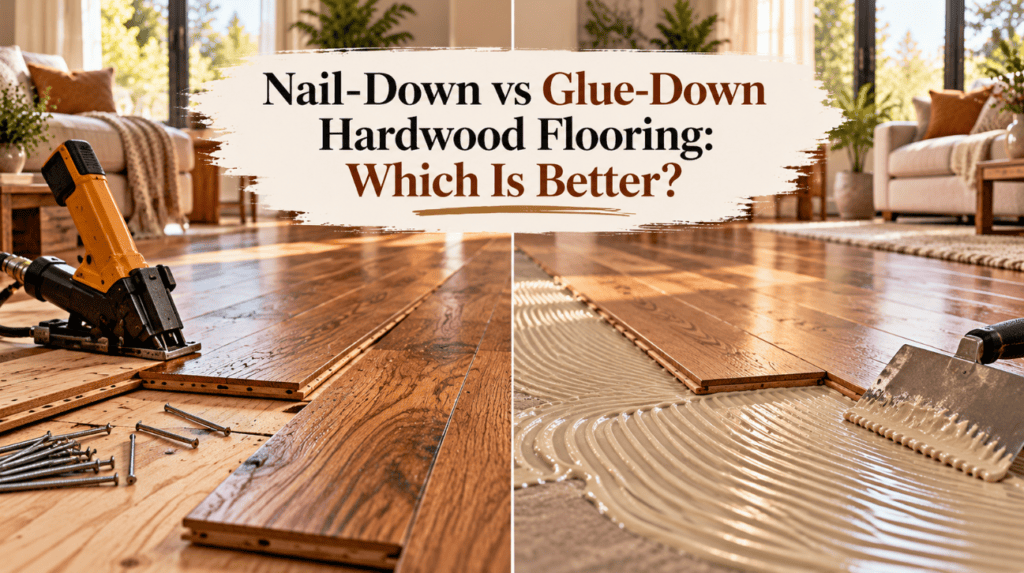
Nail-Down vs Glue-Down Hardwood Flooring: Which Is Better?
When installing hardwood flooring, choosing the right installation method is just as important as choosing the wood itself. Two of the most common methods are nail-down and glue-down installation.
The main difference is simple: nail-down hardwood is secured to a wooden subfloor with flooring nails or staples, while glue-down hardwood is bonded directly to the subfloor with flooring adhesive.
So, which is better?
Nail-down installation is often best for solid hardwood installed over a suitable plywood or wooden subfloor. Glue-down installation is often better for engineered hardwood, concrete subfloors, and situations where reducing floor movement or hollow sound is important.
Neither method is automatically superior. The right choice depends on the flooring type, subfloor, moisture conditions, room location, budget, and long-term repair needs.
This guide explains the differences between nail-down and glue-down hardwood flooring so you can choose the right installation method for your home.
What Is Nail-Down Hardwood Flooring?
Nail-down installation involves attaching hardwood planks directly to a wooden subfloor using flooring cleats, nails, or staples.
The fasteners are usually installed through the tongue of each plank at an angle so they remain hidden once the next board is installed.
Nail-down installation is commonly used for:
- Solid hardwood flooring
- Engineered hardwood
- Plywood subfloors
- Wooden subfloors
- Above-grade installations
When installed correctly, the flooring feels firm and secure underfoot.
What Is Glue-Down Hardwood Flooring?
Glue-down installation uses a flooring adhesive to bond hardwood or engineered wood directly to the subfloor.
The installer spreads adhesive across a prepared section of the subfloor and presses each plank into place.
Glue-down installation is commonly used for:
- Engineered hardwood
- Concrete slabs
- Ground-floor installations
- Condominiums
- Apartments
- Areas where reduced movement is desirable
The adhesive creates continuous contact between the flooring and subfloor, which can produce a solid feel and reduce hollow sounds.
Nail-Down vs Glue-Down Hardwood Flooring at a Glance
Here is the simplest comparison:
Nail-Down Installation
Often best when you have:
- A plywood or wooden subfloor
- Solid hardwood flooring
- A traditional hardwood installation
- A need for easier future board replacement
- Suitable subfloor thickness for fasteners
Glue-Down Installation
Often best when you have:
- A concrete subfloor
- Engineered hardwood
- A need to minimize movement
- Concerns about hollow footfall sounds
- A flooring product specifically designed for adhesive installation
The flooring manufacturer’s instructions should always be checked before selecting either method.
Subfloor Compatibility
Subfloor type is one of the biggest factors when choosing between nail-down and glue-down installation.
Nail-Down Over Wood Subfloors
Nails and staples need something secure to penetrate.
For this reason, nail-down installation is generally suited to plywood or appropriate wooden subfloors.
The subfloor must be:
- Structurally sound
- Flat
- Dry
- Clean
- Properly secured
If the subfloor flexes or contains loose sections, the hardwood may later squeak or move.
Glue-Down Over Concrete
Glue-down installation is frequently used over concrete because flooring nails cannot simply be driven into a concrete slab using standard wood-floor installation methods.
However, concrete must be carefully prepared.
Before installation, professionals may check:
- Moisture levels
- Surface flatness
- Cracks
- Contaminants
- Old adhesive
- Concrete condition
A suitable moisture-control system or adhesive may also be required.
Best choice depends on the subfloor rather than personal preference alone.
Which Method Is Better for Solid Hardwood?
Nail-down installation is traditionally one of the preferred methods for solid hardwood.
Solid hardwood naturally expands and contracts as moisture conditions change.
When nailed correctly over a suitable wooden subfloor, each board has secure fastening while still allowing the flooring system to accommodate normal seasonal movement.
Glue-down installation of solid hardwood is possible only with certain products and conditions. It should not be assumed that every solid hardwood floor can be glued directly to the subfloor.
Follow the flooring manufacturer’s installation instructions.
Which Method Is Better for Engineered Hardwood?
Engineered hardwood offers more installation flexibility.
Depending on the product, it may be:
- Nailed
- Stapled
- Glued
- Floated
Glue-down installation is especially common with engineered hardwood over concrete slabs.
Because engineered hardwood is built from multiple layers, it generally offers greater dimensional stability than solid wood.
However, installation requirements still vary significantly between manufacturers.
Which Installation Feels More Solid Underfoot?
Both methods can feel solid when installed correctly.
Glue-down flooring often feels particularly firm because much of the plank is bonded directly to the subfloor.
This can reduce vertical movement.
Nail-down hardwood can also feel extremely solid, especially when installed over a properly prepared wooden subfloor.
If either method feels loose or bouncy, the problem may involve:
- Poor subfloor preparation
- Uneven surfaces
- Incorrect fastener spacing
- Adhesive failure
- Loose subfloor panels
The installation quality often matters more than the method itself.
Which Method Is Quieter?
Glue-down hardwood may produce less hollow footfall noise because the adhesive creates direct contact between the boards and subfloor.
This can be useful in:
- Condominiums
- Apartments
- Multi-story homes
- Bedrooms
- Upper-level rooms
Nail-down flooring can also be quiet when the subfloor is stable and installation is performed correctly.
Squeaks in a nail-down floor may develop when boards or subfloor panels move against fasteners.
If sound transmission is a major concern, additional acoustic requirements may need to be considered before installation.
Which Method Is Faster to Install?
Installation time depends on:
- Room size
- Flooring type
- Subfloor preparation
- Installer experience
- Layout complexity
- Moisture testing
- Adhesive curing requirements
Nail-down installation can move efficiently once the subfloor has been prepared.
Glue-down installation requires careful adhesive application and may involve working in smaller sections.
Certain adhesives may also require specific open times or curing periods.
You should therefore compare total project requirements rather than assuming one method is always faster.
Which Method Creates Less Mess?
Both methods create some installation cleanup.
Nail-down flooring requires cutting boards and handling fasteners but does not normally involve spreading adhesive over large sections of the floor.
Glue-down installation requires careful adhesive management.
Adhesive accidentally transferred onto the hardwood surface must usually be removed quickly using the manufacturer’s approved method.
Once cured, some adhesives can be difficult to remove without affecting the finish.
Experienced installation helps minimize this risk.
Cost: Nail-Down vs Glue-Down
There is no universal winner on installation cost.
Nail-Down Costs
Potential costs include:
- Nails or staples
- Flooring underlayment where required
- Labor
- Subfloor preparation
The process may be cost-effective when the home already has a suitable wooden subfloor.
Glue-Down Costs
Glue-down installation requires professional-quality adhesive.
Certain projects may also need:
- Moisture-control adhesive
- Concrete preparation
- Crack repair
- Primers
- Surface leveling
These materials can increase installation costs.
The best comparison is the complete installed price, including subfloor preparation.
Moisture Considerations
Moisture is critical for both installation methods.
Hardwood installation should not begin until the flooring, subfloor, and room conditions meet the manufacturer’s requirements.
Nail-Down Moisture Issues
Excess moisture can cause:
- Cupping
- Buckling
- Gaps
- Board movement
- Squeaking
Wood subfloors should be tested before installation.
Glue-Down Moisture Issues
Concrete slabs can release moisture vapor.
If moisture conditions are too high, the adhesive bond may fail or the hardwood may become damaged.
Some modern adhesive systems provide moisture-control properties, but they must be selected and applied correctly.
Professional moisture testing is essential before installing hardwood over concrete.
Which Method Is Easier to Repair?
Nail-down hardwood can sometimes be easier to repair because individual boards may be removed by cutting the damaged plank and carefully releasing the fasteners.
Glue-down boards can be more difficult to remove because the plank is bonded directly to the subfloor.
Replacing one glued board may require:
- Cutting the damaged board
- Removing old adhesive
- Preparing the exposed subfloor
- Applying new adhesive
- Installing a matching replacement plank
Both repairs are possible, but glue-down repairs can require more effort.
Can Nail-Down Hardwood Be Refinished?
Yes.
Whether hardwood can be refinished depends mainly on the flooring itself rather than whether it was nailed or glued.
Solid hardwood can often be refinished several times if sufficient wood remains above the tongue-and-groove system.
Engineered hardwood may be refinished only when its real wood wear layer is thick enough.
Can Glue-Down Hardwood Be Refinished?
Yes, many glue-down engineered hardwood floors can be refinished if they have a sufficiently thick wear layer.
However, refinishing suitability depends on:
- Wear-layer thickness
- Floor flatness
- Previous sanding
- Board condition
- Adhesive stability
A flooring professional should inspect engineered hardwood before sanding.
Nail-Down Hardwood: Pros and Cons
Advantages
Nail-down installation offers:
- Strong traditional installation
- Good performance with solid hardwood
- Suitability for wooden subfloors
- No large quantities of adhesive
- Potentially easier board repairs
- Long-term installation reliability
Disadvantages
Potential disadvantages include:
- Not suitable directly over typical concrete slabs
- Requires appropriate wooden subfloor
- Improper fastening may cause squeaking
- Specialized flooring nailers are required
- Fastener placement must be precise
Glue-Down Hardwood: Pros and Cons
Advantages
Glue-down installation offers:
- Excellent use over suitable concrete
- Strong option for engineered hardwood
- Reduced floor movement
- Solid feel underfoot
- Reduced hollow footfall sound
- Broad application in ground-level properties
Disadvantages
Potential disadvantages include:
- Higher adhesive costs
- More challenging individual board repairs
- Adhesive cleanup is important
- Subfloor preparation must be precise
- Concrete moisture problems must be addressed
- Installation can be less forgiving
Nail-Down or Glue-Down: Which Should You Choose?
Choose nail-down hardwood flooring when you have a suitable wooden subfloor and are installing solid hardwood or a compatible engineered product.
It is a particularly strong choice when you want:
- Traditional installation
- Secure fastening
- Easier future board repair
- Solid hardwood flooring
Choose glue-down hardwood flooring when you have a concrete slab, are installing compatible engineered hardwood, or want to minimize vertical movement and hollow sound.
It may be particularly useful for:
- Concrete foundations
- Engineered wood
- Condominiums
- Ground-floor installations
The best method should ultimately be determined by the flooring product and subfloor conditions.
Why Subfloor Preparation Matters More Than the Installation Method
An expensive hardwood floor can fail regardless of whether it is nailed or glued if the subfloor is not properly prepared.
Before installation, the subfloor should be checked for:
- Moisture
- Flatness
- Structural stability
- Loose sections
- Cracks
- Contaminants
- Height differences
Concrete may need leveling or moisture treatment.
Wood subfloors may need additional fastening or replacement of damaged panels.
Professional preparation reduces the risk of squeaks, loose planks, adhesive failure, gaps, and uneven flooring.
Why Professional Hardwood Installation Matters
Choosing between nail-down and glue-down methods is not something that should be based only on price.
Experienced hardwood floor installers can evaluate the flooring product, subfloor, moisture conditions, room location, and manufacturer requirements before selecting the installation system.
Correct installation also helps protect the flooring warranty and reduce the likelihood of future repairs.
Why Choose ElmWood Flooring?
ElmWood Flooring provides professional hardwood flooring installation, repair, refinishing, and restoration services.
Before recommending nail-down or glue-down installation, ElmWood Flooring can evaluate:
- Subfloor material
- Concrete moisture
- Wood moisture levels
- Flooring construction
- Room location
- Existing floor conditions
- Sound requirements
- Manufacturer specifications
For homes with plywood or wood subfloors, nail-down installation may offer a reliable traditional solution.
For engineered hardwood over concrete, glue-down installation may provide greater practicality and stability.
ElmWood Flooring can also identify subfloor problems before installation begins, helping prevent issues such as loose boards, squeaking, cupping, gaps, or adhesive failure.
Instead of using the same installation method for every project, ElmWood Flooring can recommend an approach based on the specific flooring and property conditions.
Frequently Asked Questions
Is nail-down better than glue-down hardwood?
Not necessarily. Nail-down is often better for solid hardwood over wood subfloors, while glue-down is often better for engineered hardwood over concrete.
Can hardwood be glued directly to concrete?
Certain engineered hardwood products can be glued to properly prepared concrete using an approved adhesive. Moisture testing is essential before installation.
Can you nail hardwood into concrete?
Traditional nail-down hardwood installation requires a suitable wooden subfloor or another approved fastening system. Standard flooring nails are not used directly in concrete in the same way they are used with plywood.
Does glue-down hardwood feel more solid?
Glue-down flooring often feels firm because the planks are bonded directly to the subfloor. Properly installed nail-down hardwood can also feel very solid.
Is glue-down hardwood quieter?
Glue-down installation may reduce hollow footfall sound because there is continuous contact between the floor and subfloor.
Is nail-down hardwood easier to repair?
Individual nail-down planks can sometimes be easier to remove and replace than fully adhered boards.
Can engineered hardwood be nailed down?
Yes, many engineered hardwood products can be nailed or stapled over suitable wood subfloors. Always follow the manufacturer’s installation instructions.
Can engineered hardwood be glued down?
Yes. Glue-down installation is widely used for compatible engineered hardwood products, particularly over concrete.
Which installation method is more expensive?
The answer depends on subfloor preparation, adhesive requirements, labor, and flooring type. Glue-down installation may involve additional adhesive and moisture-control costs.
Which method lasts longer?
Both nail-down and glue-down hardwood can last for decades when the flooring is high quality, the subfloor is properly prepared, and installation is performed correctly.
Final Thoughts
The choice between nail-down and glue-down hardwood flooring depends primarily on the flooring type and subfloor.
Nail-down installation is a proven option for solid and compatible engineered hardwood over plywood or wooden subfloors. It provides secure fastening and can make individual board repairs relatively straightforward.
Glue-down installation is particularly useful for engineered hardwood over concrete. It can reduce movement, create a solid feel underfoot, and minimize hollow sound.
Neither method compensates for poor subfloor preparation or uncontrolled moisture.
For professional evaluation and installation, ElmWood Flooring can inspect your flooring, subfloor, and moisture conditions and recommend whether nail-down or glue-down installation provides the best long-term solution for your home.

