

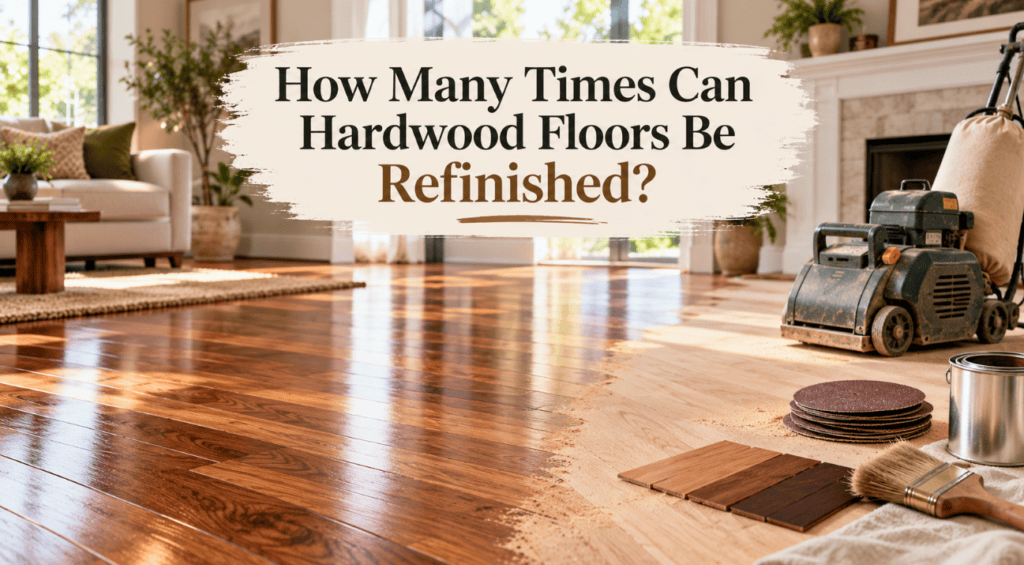
How Many Times Can Hardwood Floors Be Refinished?
Most solid hardwood floors can typically be refinished about 4 to 6 times over their lifetime, while engineered hardwood may be refinished 0 to 3 times, depending mainly on the thickness of its real wood wear layer.
However, there is no single number that applies to every floor.
How many times a hardwood floor can be refinished depends on:
- Board thickness
- Wear-layer thickness
- Previous sanding
- Floor condition
- Wood species
- Installation method
- Depth of scratches or stains
- Whether the floor is solid or engineered
A hardwood floor that has been sanded aggressively several times may have little usable wood left, even if it still looks thick from above. On the other hand, a well-maintained solid hardwood floor may last for many decades and support multiple refinishing cycles.
This guide explains how many times hardwood floors can be refinished, how to tell if your floor has enough wood left, and when recoating or repair may be better than full sanding.
What Does Refinishing a Hardwood Floor Mean?
Hardwood floor refinishing generally involves removing the existing surface finish and a small amount of wood through sanding.
The floor is then prepared for:
- Stain, if desired
- Sealer
- Protective finish
- Multiple finish coats
Refinishing can remove or reduce:
- Scratches
- Worn finish
- Uneven color
- Minor stains
- Surface damage
- Fading
- Dull areas
The process exposes fresh wood and creates a renewed surface.
Because sanding removes some of the floor itself, hardwood cannot be refinished an unlimited number of times.
How Many Times Can Solid Hardwood Be Refinished?
Solid hardwood is generally the most refinishable type of wood flooring.
Many traditional solid hardwood boards are approximately 3/4 inch thick. However, the usable sanding depth is limited by the tongue-and-groove construction.
Once sanding approaches the tongue, nails, or fasteners, further refinishing may weaken the boards.
In many cases, solid hardwood may support approximately 4 to 6 full refinishing cycles during its lifetime.
Some floors may allow fewer refinishes if:
- They were aggressively sanded previously.
- Deep stains require heavy sanding.
- The boards were thin when installed.
- The floor is uneven.
- Damage has reduced usable thickness.
A lightly sanded and well-maintained floor may retain more material for future refinishing.
How Many Times Can Engineered Hardwood Be Refinished?
Engineered hardwood requires more careful evaluation.
Unlike solid hardwood, engineered flooring contains only a thin layer of real hardwood on top of a layered core.
This surface is called the wear layer.
The thickness of the wear layer determines whether the floor can be sanded.
As a general guide:
- Less than 1 mm: Usually should not be fully sanded
- 1–2 mm: May allow very light restoration or screening
- 2–3 mm: May support approximately one refinishing
- 3–4 mm: May support one to two refinishing cycles
- 4 mm or thicker: May support two or more refinishes
These are general guidelines, not guarantees.
The exact number depends on the product’s construction and how much material has already been removed.
Before sanding engineered hardwood, a professional should inspect the wear layer.
What Determines How Many Times a Floor Can Be Refinished?
1. Thickness of the Wood
Thickness is the most important factor.
With solid hardwood, installers must determine how much usable wood remains above the tongue-and-groove system.
With engineered hardwood, they must evaluate the thickness of the real wood wear layer.
A thick board does not necessarily mean all of that thickness can be sanded.
2. Previous Refinishing
Every full refinishing removes a small amount of wood.
If the floor has already been refinished several times, there may not be enough material left for another aggressive sanding.
Older homes may have hardwood floors that have been sanded repeatedly over several decades.
Signs of previous heavy sanding can include:
- Visible nail heads
- Very thin board edges
- Uneven boards
- Cracking near the tongue
- Exposed fasteners
- Reduced height near transitions
A professional inspection can help determine the floor’s remaining sanding life.
3. Condition of the Floor
The amount of material that needs to be removed affects how much usable wood remains afterward.
A floor with only surface scratches may require relatively light sanding.
A floor with deep pet scratches, dark water stains, or severe wear may require deeper sanding.
The more wood removed during one refinishing cycle, the fewer refinishing opportunities remain.
4. Wood Species
Some hardwood species respond differently to sanding.
Dense woods may resist surface damage well, while softer species can develop deeper dents and scratches.
However, the species itself does not determine the total number of refinishes as much as board thickness and sanding history.
5. Flooring Flatness
An uneven floor may require more sanding to create a smooth surface.
Boards with cupping or crowning may need extra material removed.
However, moisture-related problems should always be corrected before sanding.
Sanding a wet, cupped floor may create permanent unevenness after the wood dries.
How Do You Know If Hardwood Can Be Refinished Again?
A flooring professional may inspect several areas before deciding whether another refinishing cycle is safe.
They may look at:
- Floor vents
- Heating registers
- Door transitions
- Damaged boards
- Floor edges
- Exposed board profiles
These areas can sometimes reveal the remaining thickness.
Warning signs that the floor may be too thin include:
- Nails becoming visible
- Boards cracking along edges
- Tongues beginning to show
- Very thin wood above the tongue
- Previous aggressive sanding
- Weak or splintering planks
Do not assume a floor can be refinished based only on its age.
A 70-year-old floor that was rarely sanded may have more usable wood than a 25-year-old floor that was refinished multiple times.
Refinishing vs Recoating: What’s the Difference?
Not every worn floor needs full refinishing.
Refinishing
Refinishing removes the existing finish and sands into the wood surface.
It is appropriate when the floor has:
- Deep scratches
- Bare wood
- Heavy discoloration
- Significant fading
- Damaged stain
- Uneven surface wear
Recoating
Recoating usually involves lightly preparing the existing finish and applying a new protective coating.
It removes little or no actual wood.
Recoating may be suitable when:
- The finish looks dull.
- Light surface scratches are present.
- The protective coating is wearing thin.
- The wood beneath the finish is still in good condition.
Choosing recoating when possible can preserve the wood and extend the number of years before full refinishing becomes necessary.
How Often Should Hardwood Floors Be Refinished?
Hardwood floors do not need refinishing according to a fixed schedule.
A floor may go many years before requiring full sanding.
The timing depends on:
- Household traffic
- Pets
- Children
- Furniture movement
- Cleaning habits
- Finish quality
- Wood species
- Sun exposure
A low-traffic bedroom may remain in excellent condition far longer than a hallway, kitchen, or living room.
Instead of refinishing based solely on age, look at the condition of the surface.
Signs Your Hardwood Floor May Need Refinishing
Consider professional refinishing when you notice:
Deep Scratches
Minor scratches may affect only the finish, but deep scratches that expose bare wood often require more extensive restoration.
Gray or Discolored Areas
Gray wood may indicate that the protective finish has worn away and moisture has begun affecting the exposed surface.
Widespread Dullness
A floor that remains dull after proper cleaning may have a worn finish.
Recoating may sometimes solve this problem without full sanding.
Dark Stains
Water, pet accidents, and spills can create dark stains.
Some stains can be reduced through sanding, while deep discoloration may require board replacement.
Uneven Color
Sun exposure and area rugs can produce noticeable color differences.
Refinishing may create a more consistent appearance.
Exposed Wood
If the protective coating has worn completely away, the exposed wood is more vulnerable to stains and moisture.
When Should You Avoid Refinishing?
Full refinishing may not be appropriate when:
- The boards are too thin.
- Engineered hardwood has a very thin wear layer.
- The floor is actively warped.
- Moisture is still present.
- Boards are structurally damaged.
- The subfloor is unstable.
- Extensive delamination has occurred.
- Too many previous sandings have been performed.
In these cases, repair or replacement may provide better results.
Can Hardwood Be Refinished Without Sanding?
Yes, in some situations.
If the existing finish is worn but the wood underneath remains in good condition, screening and recoating may restore protection without full sanding.
This process can help with:
- Minor scratches
- Surface dullness
- Light wear
- Loss of sheen
It will not remove:
- Deep scratches
- Dark stains
- Major discoloration
- Severe unevenness
The advantage of recoating is that it preserves more of the wood.
Can Prefinished Hardwood Be Refinished?
Yes.
Many solid prefinished hardwood floors can be sanded and refinished.
The factory finish may be durable, which can make sanding more demanding, but the floor itself can usually be restored if enough wood remains.
Micro-beveled edges may also require additional consideration.
Engineered prefinished hardwood should be inspected carefully because its refinishability depends on the wear layer.
Can Old Hardwood Floors Be Refinished?
Yes, and older hardwood often responds very well to professional restoration.
Age alone does not mean a floor needs replacement.
Old hardwood may still be a good refinishing candidate when:
- The boards remain structurally sound.
- Enough thickness remains.
- There is no severe moisture damage.
- The tongue-and-groove system is intact.
- The subfloor remains stable.
Older flooring can sometimes offer high-quality wood that is difficult or expensive to replace.
What Happens If Hardwood Is Sanded Too Many Times?
Over-sanding can permanently weaken a floor.
Possible problems include:
- Exposed nails
- Splintering edges
- Cracked boards
- Visible tongues
- Reduced structural strength
- Loose boards
- Uneven surfaces
Once there is insufficient wood above the tongue, additional sanding may no longer be safe.
At that point, selective board replacement or full flooring replacement may be required.
How Can You Make Hardwood Floors Last Longer Between Refinishing?
Good maintenance can significantly delay the need for sanding.
Remove Grit Regularly
Dust, sand, and small stones can scratch the finish.
Sweep, dust-mop, or vacuum regularly.
Clean Spills Immediately
Water and other liquids can damage the finish and stain exposed wood.
Use Furniture Pads
Place felt pads beneath furniture legs and replace them when worn.
Use Area Rugs
Protect high-traffic areas with breathable rugs.
Avoid products that may trap moisture or discolor the finish.
Trim Pet Nails
Pet nails can create scratches that gradually damage the protective coating.
Avoid Steam Cleaning
Steam can introduce moisture into floor seams and damage the finish or boards.
Use Hardwood-Safe Cleaners
Avoid abrasive or harsh household chemicals.
Consider Recoating Early
Do not wait until large areas of bare wood appear.
A timely recoat may protect the surface and delay full refinishing.
When Should You Call a Professional?
Contact a flooring specialist when:
- You do not know how many times the floor has been refinished.
- Nail heads are visible.
- The floor appears unusually thin.
- You have engineered hardwood.
- There are deep stains.
- Boards are warped or cupped.
- You are unsure whether to recoat or refinish.
- Previous refinishing produced uneven results.
- The floor contains damaged or loose boards.
Experienced hardwood floor installers can inspect the boards, floor thickness, wear layer, moisture condition, and previous sanding history before recommending the safest approach.
Why Choose ElmWood Flooring?
ElmWood Flooring provides professional hardwood floor refinishing, installation, repair, and restoration services.
Before recommending full sanding, the ElmWood Flooring team can inspect the existing floor and determine whether refinishing is actually necessary.
The assessment may include:
- Remaining board thickness
- Wear-layer thickness
- Previous sanding
- Surface damage
- Moisture conditions
- Loose or damaged boards
- Existing finish
- Overall floor stability
If the floor has enough usable wood remaining, professional refinishing can restore its appearance and extend its useful life.
If full sanding is unnecessary, ElmWood Flooring may recommend a less aggressive restoration method, such as recoating.
When individual boards are damaged beyond repair, selective replacement may also help preserve the rest of the floor rather than replacing everything.
The goal is to use the least destructive method that delivers a durable and attractive result.
Frequently Asked Questions
How many times can 3/4-inch hardwood flooring be refinished?
Many 3/4-inch solid hardwood floors can be refinished approximately four to six times, depending on how aggressively they were sanded previously and how much usable wood remains above the tongue.
Can hardwood floors be refinished more than five times?
Sometimes. A thick floor that has received light sanding may support additional refinishing, but a professional should inspect it before another sanding cycle.
How many times can engineered hardwood be refinished?
Engineered hardwood may support anywhere from zero to several refinishing cycles depending on the thickness of its real wood wear layer.
How can I tell how thick my hardwood floor is?
A flooring professional may inspect the board profile near vents, transitions, damaged sections, or floor edges to estimate remaining thickness.
Does refinishing make hardwood floors thinner?
Yes. Sanding removes a small amount of wood each time, which is why hardwood cannot be refinished indefinitely.
Is it better to recoat or refinish hardwood floors?
Recoating is better when the existing finish has light wear but the wood underneath remains in good condition. Refinishing is more suitable for deep scratches, staining, and exposed wood.
Can scratched hardwood floors be refinished?
Yes. Refinishing can remove many scratches, although extremely deep damage may require more sanding or board replacement.
Can engineered hardwood be sanded?
Some engineered hardwood can be sanded, but the wear layer must be thick enough. Thin-veneer products should not be aggressively sanded.
How long do refinished hardwood floors last?
The new finish can last for many years depending on traffic, finish quality, maintenance, pets, furniture movement, and household conditions.
When should hardwood floors be replaced instead of refinished?
Replacement may be necessary when boards are structurally damaged, excessively thin, badly warped, severely water-damaged, or unable to support another sanding cycle.
Final Thoughts
Most solid hardwood floors can be refinished approximately four to six times, while engineered hardwood may support anywhere from zero to several refinishing cycles depending on its wear-layer thickness.
The exact number is determined by the amount of usable wood remaining, previous sanding, floor condition, and depth of the damage.
Full refinishing is not always necessary. Floors with minor surface wear may benefit from recoating, helping preserve the wood for future restoration.
Before sanding an older or engineered hardwood floor, professional evaluation is important. Removing too much material can expose nails, weaken boards, or damage the flooring permanently.
ElmWood Flooring can inspect your floor, determine whether it has enough material for another refinishing cycle, and recommend refinishing, recoating, repair, or replacement based on its actual condition.

