

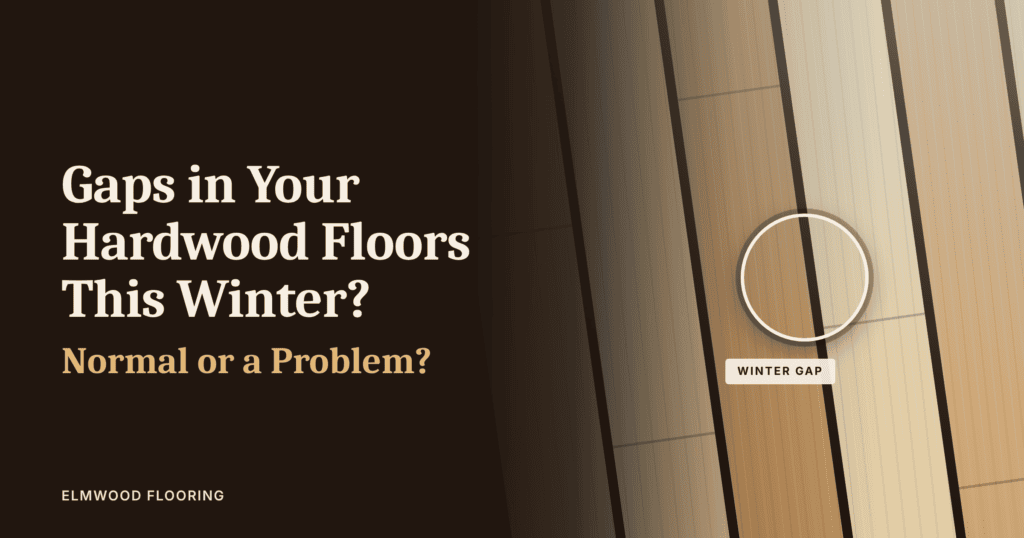
Gaps that open between hardwood boards in winter are often a normal part of how real wood behaves. When the heating season dries indoor air, the boards lose moisture and shrink slightly, and gaps can appear. Many of these gaps close again as humidity returns in spring. But winter gaps can also point to problems with installation conditions, past water damage or the subfloor. The way to tell the difference is to look at when the gaps appear, how they behave over the year and what other symptoms come with them, not just how wide they are.
This guide focuses only on diagnosing winter gaps. For the broader picture of how humidity and Chicago’s climate affect wood floors, see Elmwood’s articles “How Does Humidity Affect Hardwood Floors?” and Can Chicago Weather Affect My Hardwood Floors?
Key takeaways
- Gaps that appear in the heating season and close as humidity returns are usually normal seasonal movement.
- Gap size alone does not show whether there is a problem. Timing, pattern and other symptoms matter more.
- How much a floor moves depends on several factors together: species, board width, how the wood was cut, construction, and installation conditions.
- Monitoring humidity and using properly controlled humidification and dehumidification is the best way to limit movement.
- Gaps that persist all year, or that come with cupping, lifting or past leaks, should be inspected.
Why boards shrink in winter
Wood constantly exchanges moisture with the air around it. When indoor air is dry, boards release moisture and shrink, mostly across their width. When air is humid, they absorb moisture and swell. In Chicago, heating dries indoor air significantly in winter, so this is the season when gaps usually show.
Seasonal movement through the year
In many Chicago homes without year-round humidity control, a hardwood floor follows a predictable cycle:
| Season | Indoor air | What the floor typically does |
| Late fall | Drying as the heat comes on | Boards begin to shrink, and the first gaps may appear |
| Winter | Driest | Gaps are usually most noticeable |
| Spring | Humidity rising | Gaps begin to close |
| Summer | Most humid | Boards are at their fullest, and cupping is possible if humidity is high |
| Early fall | Moderate | The floor is often at its most stable |
A floor that follows this cycle is behaving like real wood. A floor that does not, such as one that gaps in summer or cups badly in one area, deserves a closer look.
What determines how much a floor moves
No single factor decides how much a floor will shrink or swell. Several work together:
- Species. Different species respond differently to changes in moisture.
- Board width. Wider boards generally show more movement per board than narrower boards of the same species and cut.
- How the wood was cut. Quartersawn and rift-sawn boards are generally more stable in width than plainsawn boards of the same species.
- Construction. Engineered hardwood’s cross-layered core usually moves less than solid wood, though it can still show small gaps.
- Installation conditions. The moisture content of the wood and subfloor at installation, and the indoor conditions at the time, affect how the floor behaves in its first seasons.
That is why two floors in the same house can behave differently, and why one rule of thumb rarely fits every floor.
Normal seasonal gaps vs. signs of a problem
Gap size alone does not tell you whether something is wrong. Instead, look at timing, pattern and other symptoms.
Usually normal:
- Gaps appear as the heating season begins and close as humidity returns
- Gaps are spread fairly evenly across the floor
- Boards are otherwise flat and secure, with no cupping, lifting or soft spots
Worth having inspected:
- Gaps stay open all year, including humid months
- Gaps are concentrated in one area, such as near a heat source, exterior wall or plumbing
- Boards are also cupping, crowning or lifting
- Several boards move together as a block, leaving a few large gaps. This is called panelization. It can be associated with finish that bonds board edges together, but other installation or subfloor conditions can also contribute, so it is worth having a professional assess.
- Gaps appeared after a leak, flood or plumbing repair
- Gaps get noticeably worse from one year to the next
Managing humidity the right way
The most effective way to limit seasonal gaps is to keep indoor humidity steady and within the range your flooring manufacturer specifies. Most manufacturers publish a recommended range in their care and warranty documents, and that range takes precedence. Where no manufacturer range is provided, the National Wood Flooring Association generally recommends keeping relative humidity between 30% and 50%.
- Monitor first. Place an inexpensive hygrometer in a few rooms, so you see what the floor actually experiences across seasons.
- Humidify in winter, with control. A properly sized and maintained humidifier, ideally whole-house and set to a target level, helps keep winter humidity in range. Avoid over-humidifying, which can cause condensation on windows.
- Dehumidify in summer. Air conditioning or a dehumidifier keeps summer humidity from climbing, which reduces swelling and cupping.
- Aim for stability. Big swings matter more than any single reading. Steady conditions through the year produce the least movement.
Do not fill normal seasonal gaps. Filling a temporary gap leaves the boards no room to expand. When humidity rises and the boards swell again, the filler can cause compression-related damage, such as crushed board edges or cupping, or be pushed back out of the gap. Permanent gaps in a floor with steady humidity are a different matter and can be repaired by a professional.
Installation conditions matter
Many gap problems trace back to installation day. Before a floor is installed, the wood and the subfloor should both be checked with a moisture meter, and the home should be at normal living conditions, with heating or cooling running. Following the manufacturer’s acclimation guidance helps the floor start at a moisture level that matches the home. A floor installed during an unusually humid or dry stretch, or without these checks, may show more movement in its first year. Elmwood’s flooring installation work includes these checks. For rooms where stability is a priority, engineered hardwood is often worth considering.
What a proper gap assessment includes
When gaps don’t follow the normal seasonal pattern, a proper assessment looks at the whole picture, not a single reading:
- Indoor temperature
- Indoor relative humidity
- Moisture content of the flooring
- Moisture content of the subfloor
- Potential moisture sources, such as leaks, plumbing, a damp crawl space or basement
Together, these show whether the floor is simply responding to dry winter air, or whether another condition is involved. That distinction decides the fix: humidity control, repairing a moisture source, or repairing the floor.
When to call a professional
Contact a flooring professional if:
- Gaps remain through the humid months
- The floor is cupping, crowning, lifting or feels soft
- You see panelization, with a few large gaps between groups of boards
- Gaps appeared after water damage or plumbing work
- You are planning to refinish and want to know whether the floor is stable enough
Depending on the cause, repairs can include correcting humidity, fixing a moisture source, inserting matching wood slivers into permanent gaps, replacing damaged boards, or refinishing once the floor has stabilized. Sanding a cupped floor before it dries can leave the boards crowned later, so timing matters.
How Elmwood Flooring helps
Elmwood Flooring has served Chicago since 1976. An on-site inspection includes moisture testing, so you get a clear answer on whether your gaps are seasonal or a sign of something that needs repair. If your hardwood floors need work, the team can handle repairs, refinishing or replacement under a written agreement. Elmwood’s crews are licensed, insured and bonded.
Contact Elmwood Flooring if your floor’s gaps don’t follow the seasons.
Frequently asked questions
How soon can someone inspect my floor?
Start with a free phone quote. Elmwood typically responds to quote requests within 24 hours or by the next business day to arrange an in-home visit, and inspection timing depends on crew availability.
Is there a charge for an inspection or estimate?
Phone quotes are free. An in-home or business estimate carries a one-time travel fee of $20, $40 or $50, depending on your distance from Elmwood. The $20 fee is refunded if you hire Elmwood.
Does the warranty cover seasonal gaps?
Coverage starts on the date your proposal or contract is signed and lasts for the term stated in your contract. It covers only new work explicitly detailed in writing, and damage from leaks, pipes, people or pets is not covered. A 12-month labor warranty is typically included in addition to the manufacturer’s product warranty. Terms vary, so confirm them with your Elmwood sales agent.

