

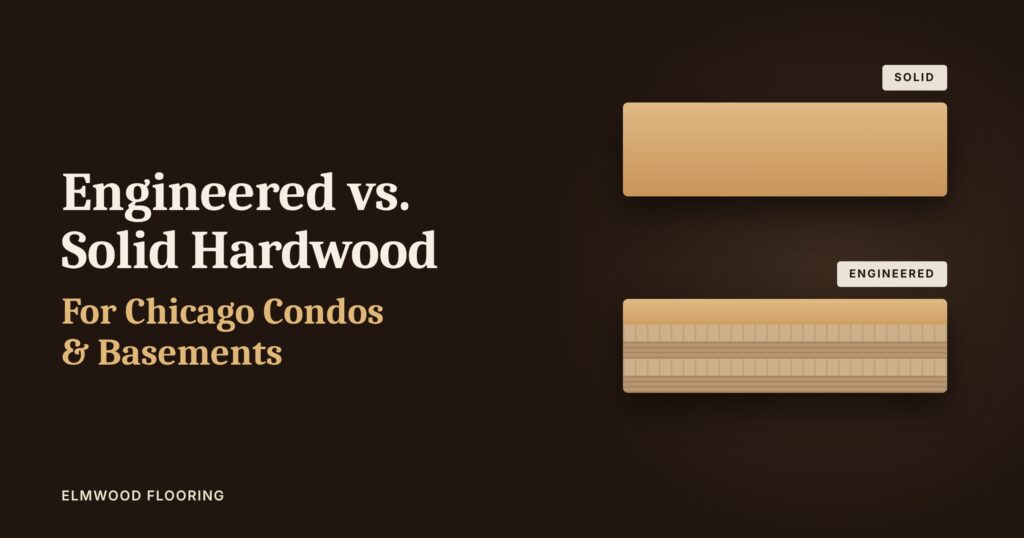
In many Chicago condos and basements, engineered hardwood is the more practical choice. Its cross-layered construction is more stable than solid wood, and it can be glued down or floated over concrete. That does not make it the automatic answer. Some solid hardwood products can be installed over properly prepared concrete or approved radiant heating systems. Engineered hardwood is not waterproof and is not suitable for every basement. The right choice depends on the subfloor, the moisture conditions, your building’s rules and the manufacturer’s specifications for the product you choose.
This guide explains how engineered hardwood flooring and solid hardwood compare in the situations Chicago homeowners ask about most.
Key takeaways
- Engineered hardwood is often the more practical choice over concrete, below grade and over radiant heat, but suitability always depends on the product and the conditions.
- Solid hardwood can go over concrete in some cases, using an approved glue-down product or a wood subfloor or sleepers over the slab.
- Engineered hardwood is not waterproof. Moisture testing, water history and the manufacturer’s below-grade approval decide whether it suits a basement.
- How many times either floor can be refinished depends on the remaining wear layer and the product’s specifications, not a fixed number.
- In condos, the complete flooring assembly must meet the building’s sound rules, and the association should approve it before you buy materials.
How solid and engineered hardwood are built
Solid hardwood is one piece of wood from top to bottom, commonly 3/4 inch thick, though thinner solid products exist. It is most often nailed or stapled to a wood subfloor. Because it is all wood, it expands and contracts noticeably as humidity changes.
Engineered hardwood has a real hardwood top layer, called the wear layer or veneer, bonded to a core underneath. Most engineered hardwood uses cross-layered construction, with core layers running in different directions, which helps the board move less with changes in humidity and temperature. From above, a quality engineered floor looks like solid wood, because the surface is real wood.
Side-by-side comparison
| Factor | Solid hardwood | Engineered hardwood |
| Over concrete | Possible with approved glue-down products, or over a plywood subfloor or sleepers | Commonly glued down or floated, per manufacturer instructions |
| Below grade (basements) | Generally not recommended by manufacturers | Often suitable when moisture testing and the manufacturer’s specs allow |
| Over radiant heat | Some products, usually narrower and more stable boards, when approved | Often preferred, but not every product is approved |
| Humidity stability | Moves more | Moves less |
| Refinishing potential | Usually several full sandings over its life | Depends on wear-layer thickness and product specs |
| Installation methods | Nail or staple; glue-down for approved products | Nail, staple, glue or float, depending on the product |
Can solid hardwood be installed over concrete?
Yes, in the right conditions. There are three common approaches:
- Direct glue-down of an approved solid product. Some manufacturers make solid flooring rated for glue-down over concrete. These products are often narrower or more dimensionally stable boards, and they are typically limited to slabs on or above grade. The manufacturer’s approved adhesive and moisture-control system must be used.
- A plywood subfloor over the slab. A properly installed wood subfloor, with moisture control, gives traditional nail-down solid hardwood something to fasten to.
- Sleepers. Wood strips fastened to the slab can support certain solid floors, though this method is not suitable for every width and thickness.
The trade-offs are real. A plywood subfloor or sleepers raise the finished floor height, which can affect doors, transitions and appliances. That matters in condos with fixed door and elevator thresholds. Every approach also depends on the slab passing moisture testing. Because of these factors, engineered hardwood is often the simpler route in Chicago high-rises, but solid hardwood is not ruled out.
Is engineered hardwood right for your basement?
Engineered hardwood is often suitable for basements, because its layered core handles below-grade conditions better than solid wood. But it is not waterproof, and it is not automatically appropriate for every basement. Three things decide:
- Moisture test results. The slab must meet the limits set by the flooring and adhesive manufacturers.
- Water history. A basement that has flooded, seeps during heavy rain or has an unreliable sump pump is a poor candidate for any wood floor.
- Manufacturer approval. The specific product must be approved for below-grade installation, with the specified moisture barrier or adhesive.
If the basement conditions do not meet the selected product’s requirements, a non-wood flooring option, such as porcelain tile or a waterproof vinyl floor, may be safer. Solid hardwood is generally not recommended below grade.
Hardwood over radiant heat
Engineered hardwood is often preferred over radiant heating, because its cross-ply construction is more dimensionally stable. Even so, not every engineered product is approved for radiant heat, so check the specifications.
Some solid hardwood can also work over approved radiant systems. Industry guidance generally favors:
- Narrower boards, which expand and contract less than wide planks
- Quartersawn or rift-sawn boards, which are more stable in width than plainsawn boards
- Species and products the manufacturer specifically approves for radiant heat
Whichever floor you choose, follow the manufacturer’s limits on surface temperature and change the heat gradually, especially at the start of the heating season.
Condo sound requirements: approve the whole assembly first
Many Chicago condo associations limit how much noise new flooring can send to the unit below. They often set minimum ratings for impact noise (IIC) and airborne noise (STC). What many owners miss is that these ratings belong to the complete floor-ceiling assembly, not just the flooring product. That assembly includes:
- The concrete slab and its thickness
- The ceiling system in the unit below
- The underlayment, acoustic membrane or sound-reducing adhesive
- The finished flooring and how it is installed
A flooring box may advertise a sound rating, but that number comes from a specific test assembly that may not match your building. To avoid buying flooring the board later rejects:
- Get the association’s flooring rules in writing, including minimum ratings, approved products and any required documentation.
- Choose a complete assembly whose test data fits your building’s construction.
- Submit the product and underlayment specifications to the association for review.
- Get written approval before purchasing materials and before any installation work begins. Installing first and seeking approval later risks having to remove and replace the floor.
- Keep the approval and product documents in case the board asks for them later, or when you sell.
Installation details matter too. Gaps at the perimeter and isolation from walls keep sound from bypassing the underlayment.
Refinishing: what the wear layer really allows
A major advantage of wood floors is that they can be renewed, but how often depends on the floor.
Solid hardwood can usually be fully sanded several times over its life. Elmwood’s guideline for a standard floor is about four to five times, depending on how much wood remains and how heavily it was sanded before.
Engineered hardwood can only be sanded through its top wear layer. How many times that is possible depends on the product’s specifications, the wear-layer thickness, where the tongue sits, and any texture or bevels. Some thin veneers should only be recoated, never sanded. Others with thicker wear layers may allow one or more careful sandings. If future hardwood refinishing matters to you, ask what refinishing the manufacturer rates the product for before you buy.
How long either floor lasts depends far more on product quality, wear layer, installation and care than on the label “solid” or “engineered.”
When solid hardwood is the better pick
Solid hardwood floors remain an excellent choice in many Chicago homes, especially:
- On or above grade, over a wood subfloor
- When you are matching or extending original solid floors in an older home
- When you want a site-finished floor with a custom stain
Matching the floor to the space
- High-rise condo on a concrete slab: Often engineered, glued down or floated over an association-approved assembly. Solid is possible with an approved system if floor height and building rules allow.
- Finished basement: Engineered may be suitable after moisture testing, if there is no water history and the product is approved below grade. Otherwise, consider tile or waterproof vinyl.
- 1920s bungalow main floor: Solid hardwood, matched to the original floors.
- Room with radiant heat: Engineered is often preferred. Narrow, stable solid boards are an option when the manufacturer approves them.
How Elmwood Flooring helps
Elmwood Flooring has served Chicago since 1976. Before installation, the team inspects the subfloor and tests for moisture, then recommends products and installation methods that fit the conditions and the manufacturer’s requirements. You can see samples in your home or visit the showroom by appointment. Elmwood’s flooring installation work is set out in a written agreement and typically carries a 12-month labor warranty in addition to the manufacturer’s product warranty. Elmwood’s crews are licensed, insured and bonded.
Planning a condo or basement floor? Contact Elmwood Flooring to talk through your space.
Frequently asked questions
Can I see samples before choosing?
Yes. Contact Elmwood during business hours, and a flooring professional can bring samples to your home or business. You can also visit the showroom by appointment.
Which floor is best if I have kids or pets?
It depends on your pets, your children and your high-traffic areas. Options include prefinished, engineered, unfinished, laminate and vinyl floors. Elmwood asks a few questions during the in-home estimate to recommend the right fit.
What if problems are found under my old floor?
Extra costs can occur. Problems hidden under the floor may only surface after the old flooring is removed, so some costs can stay uncertain until the subfloor is exposed. Ask your contractor up front how they will handle surprises such as subfloor problems or material damaged during delivery or on site.
What does the warranty cover?
Coverage starts on the date your proposal or contract is signed and lasts for the term stated in your contract. It covers only new work explicitly detailed in writing, and damage from leaks, pipes, people or pets is not covered. A 12-month labor warranty is typically included in addition to the manufacturer’s product warranty. Terms vary, so confirm them with your Elmwood sales agent.

