

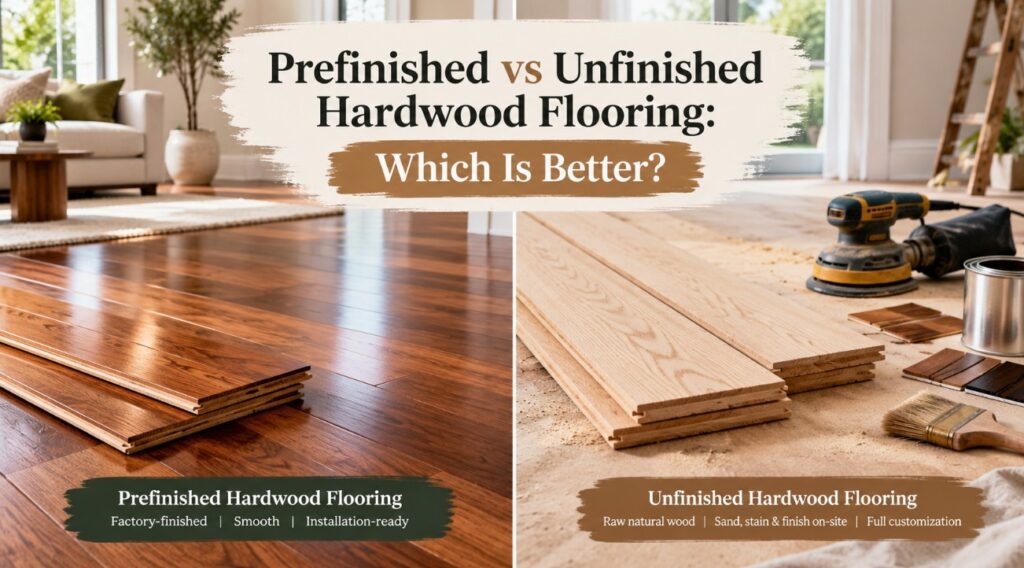
Prefinished vs Unfinished Hardwood Flooring: Which Should You Choose?
Choosing between prefinished and unfinished hardwood flooring is one of the most important decisions when planning a new wood floor.
Both options use real hardwood, but the difference comes down to when the wood is sanded, stained, and finished.
Prefinished hardwood arrives from the manufacturer already sanded, stained, and protected with a factory-applied finish. Unfinished hardwood is installed in its natural state and then sanded, stained, and sealed on-site.
So, which is better?
For most homeowners who want a faster installation, less mess, and a durable factory finish, prefinished hardwood is usually the more convenient option. Unfinished hardwood is better when you want a custom stain, a seamless surface, matching with existing flooring, or greater control over the final appearance.
The right choice depends on your home, design goals, installation schedule, budget, and long-term expectations.
This guide compares prefinished vs unfinished hardwood flooring in detail so you can decide which option makes more sense for your project.
What Is Prefinished Hardwood Flooring?
Prefinished hardwood flooring is manufactured and completely finished before it reaches your home.
The boards are typically:
- Sanded at the factory
- Stained to a specific color
- Sealed with multiple protective coats
- Cured under controlled conditions
- Ready to walk on soon after installation
Once the boards are installed, there is usually no need for additional sanding, staining, or sealing.
This makes prefinished hardwood attractive to homeowners who want a cleaner and faster installation process.
What Is Unfinished Hardwood Flooring?
Unfinished hardwood flooring, sometimes called site-finished hardwood, arrives without the final stain or protective coating.
The boards are installed first. After installation, the floor is:
- Sanded
- Smoothed
- Stained if desired
- Sealed
- Finished with protective coatings
Because the final appearance is created inside the home, unfinished hardwood gives homeowners greater control over color, sheen, and overall design.
It can also create a smoother surface because the entire installed floor is sanded at once.
Prefinished vs Unfinished Hardwood Flooring at a Glance
Here is the simplest comparison:
Choose prefinished hardwood if you want:
- Faster installation
- Less dust and odor
- A durable factory finish
- Consistent color
- Minimal downtime
- A more predictable final appearance
Choose unfinished hardwood if you want:
- A custom stain
- A smoother, more seamless look
- Better matching with existing floors
- Greater control over finish and sheen
- Easier customization for historic or unique interiors
Neither option is automatically better. The right flooring depends on your priorities.
1. Installation Time
Installation speed is one of the biggest differences between prefinished and unfinished hardwood.
Prefinished Hardwood
Prefinished boards are ready once they are installed.
There is no need to wait for:
- Sanding
- Staining
- Sealing
- Finish curing
This can significantly reduce the amount of time a room remains out of use.
For homeowners living in the property during installation, this convenience can be a major advantage.
Unfinished Hardwood
Unfinished flooring takes longer because installation is only the first stage.
After the boards are installed, the floor must be sanded, cleaned, stained, coated, and allowed to dry.
Depending on the finishing system, several coats may be required.
If reducing disruption is important, prefinished hardwood often makes more sense.
2. Appearance and Customization
Unfinished hardwood offers significantly more customization.
Prefinished Flooring
Prefinished flooring comes in predetermined colors and finishes.
Manufacturers may offer a wide selection of:
- Natural tones
- Dark stains
- Gray finishes
- Warm brown shades
- Matte finishes
- Satin finishes
- Gloss finishes
However, you are still selecting from existing options.
The advantage is predictability. You can usually see a sample and have a good idea of how the finished floor will appear.
Unfinished Flooring
Unfinished hardwood allows you to create a more personalized look.
You can choose:
- Custom stain colors
- Custom stain combinations
- Specific sheen levels
- Different finishing products
- Natural clear finishes
- Colors designed to match existing wood
This makes unfinished flooring especially useful when the new floor must blend with hardwood already installed elsewhere in the home.
3. Smoothness and Board Edges
Prefinished and unfinished flooring often feel slightly different underfoot.
Prefinished Hardwood
Because each board is finished separately at the factory, many prefinished products have slightly beveled or micro-beveled edges.
These small grooves help compensate for tiny differences between individual boards.
However, the bevels may collect dust over time if they are not cleaned regularly.
Unfinished Hardwood
Unfinished flooring is sanded after installation.
Because the entire floor is sanded together, the finished surface can feel smoother and more continuous.
The edges between boards may be less noticeable.
Homeowners looking for a traditional, seamless hardwood appearance may prefer unfinished flooring for this reason.
4. Durability
Both flooring types can be highly durable when properly installed and maintained.
However, factory finishes used on prefinished hardwood can be particularly strong.
Prefinished Hardwood Durability
Manufacturers can apply multiple finish layers under controlled factory conditions.
Some products use highly durable finishing technologies that resist:
- Scratches
- General wear
- Household stains
- Minor surface damage
This makes prefinished flooring attractive for busy households.
Unfinished Hardwood Durability
Site-finished hardwood can also provide excellent protection.
Its durability depends heavily on:
- The finish product
- Number of coats
- Application quality
- Drying conditions
- Maintenance
A professionally finished floor can last for decades.
The main advantage is that the finish can be selected according to the homeowner’s desired appearance and performance needs.
5. Dust and Odor During Installation
Prefinished hardwood is usually the cleaner installation choice.
Prefinished Hardwood
There is little or no on-site sanding after installation.
That means less:
- Wood dust
- Stain odor
- Finish odor
- Cleanup
- Disruption
This can be helpful for families who need to continue living in the house during the project.
Unfinished Hardwood
Unfinished flooring requires sanding and finishing inside the property.
Modern dust-control equipment can significantly reduce airborne dust, but the project still involves more preparation and cleanup than installing prefinished boards.
Some finishing products may also produce noticeable odors during application and curing.
6. Repairing Damaged Boards
Both types can be repaired, but the process may differ.
Repairing Prefinished Flooring
When a single prefinished plank becomes badly damaged, replacing that board may be possible.
The challenge is matching the replacement board with the surrounding floor.
Older floors may have changed color because of:
- Sunlight
- Normal aging
- Wear
- Cleaning
- Previous repairs
A brand-new board may initially look different.
Repairing Unfinished Flooring
Unfinished hardwood may be easier to blend during repairs because the replacement wood can be sanded, stained, and finished to match the surrounding floor.
However, achieving a perfect match still requires experience and careful color work.
7. Refinishing Options
Both prefinished and unfinished solid hardwood can often be refinished multiple times, depending on board thickness.
The original finishing method does not prevent future refinishing.
However, very deep bevels on some prefinished floors may require additional sanding if a completely smooth surface is desired.
For engineered prefinished hardwood, the number of possible refinishing cycles depends on the thickness of the real wood wear layer.
A professional should inspect engineered flooring before sanding.
8. Which Option Costs More?
The cost difference is not always straightforward.
Prefinished Hardwood Cost
Prefinished boards may cost more upfront because the factory finishing is already included.
However, installation may cost less because there is no need for extensive on-site sanding and finishing.
Unfinished Hardwood Cost
Unfinished boards may have a lower material cost, but you also need to budget for:
- Sanding
- Staining
- Finish materials
- Additional labor
- More installation time
The final price can therefore be similar or sometimes higher.
When comparing quotes, look at the total installed cost rather than the price of the boards alone.
9. Which Is Better for Matching Existing Hardwood?
Unfinished hardwood is usually the stronger choice when new flooring needs to blend with an existing floor.
A flooring professional can install unfinished boards and then create a stain that closely matches the surrounding wood.
In some projects, both the old and new sections may be refinished together to create a more consistent appearance.
Prefinished flooring can also work, but matching factory colors to an older floor may be more difficult.
10. Which Is Better for Renovation Projects?
The answer depends on the type of renovation.
Prefinished flooring works well when:
- You need quick installation
- Other parts of the house are occupied
- You want minimal dust
- You already know the desired color
- You want to reduce downtime
Unfinished flooring may be better when:
- You are completing a full renovation
- The home is already empty
- Existing floors need refinishing
- You want a custom color
- You are restoring a traditional interior
11. Which Is Better for New Construction?
Both options can work well in new construction.
Unfinished flooring allows builders and homeowners to coordinate the exact stain with:
- Cabinets
- Doors
- Trim
- Staircases
- Furniture
- Other wood features
Prefinished flooring can help reduce project time because there is no final sanding or finishing stage.
The decision often comes down to customization versus convenience.
12. Which Flooring Is Easier to Maintain?
Routine maintenance is similar for both.
For either type:
- Sweep or vacuum regularly.
- Remove grit before it scratches the finish.
- Clean spills immediately.
- Use a lightly damp microfiber mop.
- Choose a cleaner made for hardwood.
- Avoid steam mops.
- Avoid excessive water.
- Use furniture pads.
- Protect high-traffic areas with breathable rugs.
The specific finish matters more than whether the flooring started as prefinished or unfinished.
Pros and Cons of Prefinished Hardwood
Advantages
Prefinished hardwood offers:
- Faster installation
- Minimal on-site dust
- Less finishing odor
- Strong factory-applied coating
- Consistent color
- Immediate visual results
- Shorter room downtime
Disadvantages
Potential disadvantages include:
- Limited stain customization
- Visible micro-beveled edges
- More difficult color matching with existing floors
- Factory finish may be harder to repair invisibly
Pros and Cons of Unfinished Hardwood
Advantages
Unfinished hardwood provides:
- Custom stain options
- Greater design flexibility
- Smooth, seamless appearance
- Easier matching with existing hardwood
- Control over finish type and sheen
- Traditional site-finished appearance
Disadvantages
Potential drawbacks include:
- Longer installation
- Sanding dust
- Finish odors
- Longer curing periods
- More disruption inside the home
Which Should You Choose?
Choose prefinished hardwood flooring if convenience is your priority.
It is particularly suitable if you:
- Want a quicker installation
- Need to use the room again soon
- Prefer minimal dust and odor
- Like an available factory color
- Want a strong factory finish
Choose unfinished hardwood flooring if customization matters more.
It is a strong choice if you:
- Need to match existing hardwood
- Want a unique stain
- Prefer a completely smooth floor
- Are restoring an older property
- Want greater control over the final appearance
Why Professional Installation Matters
Even premium hardwood can perform poorly when it is installed incorrectly.
Professional installation helps ensure proper:
- Subfloor preparation
- Moisture testing
- Board acclimation
- Expansion spacing
- Fastening or adhesive application
- Layout planning
- Finishing
Experienced hardwood floor installers can also help determine whether prefinished or unfinished hardwood is better for your property based on the subfloor, existing flooring, lifestyle, design goals, and maintenance expectations.
Why Choose ElmWood Flooring?
ElmWood Flooring provides professional hardwood flooring installation, refinishing, restoration, and repair services.
The team can help homeowners compare prefinished and unfinished options based on practical factors rather than appearance alone.
ElmWood Flooring can evaluate:
- Existing flooring
- Wood species
- Subfloor conditions
- Moisture levels
- Room usage
- Desired color
- Finish preferences
- Installation timeline
- Long-term maintenance needs
If your home already has hardwood, ElmWood Flooring can also assess whether new unfinished flooring can be stained to match it or whether refinishing multiple areas together would provide a more consistent appearance.
For homeowners who want a quicker installation, ElmWood Flooring can help select and install suitable prefinished products while ensuring the subfloor and installation conditions are properly prepared.
The goal is to choose flooring that not only looks right on installation day but also performs well for years.
Frequently Asked Questions
Is prefinished hardwood better than unfinished hardwood?
Not always. Prefinished hardwood is better for faster installation and convenience, while unfinished hardwood offers greater customization and a smoother site-finished appearance.
Is prefinished hardwood more durable?
Factory finishes can be extremely durable because they are applied and cured under controlled conditions. However, professionally site-finished hardwood can also provide excellent long-term performance.
Does unfinished hardwood cost more to install?
It can. Unfinished hardwood requires sanding, staining, finishing, and additional labor after installation. Compare the total project cost rather than material prices alone.
Can prefinished hardwood be refinished?
Yes. Most solid prefinished hardwood can be sanded and refinished. The number of refinishing cycles depends mainly on the thickness of the wood.
Can unfinished hardwood be stained any color?
It offers extensive stain flexibility, although the final result depends on the wood species and how it absorbs stain. Testing stain samples before finishing the entire floor is recommended.
Why does prefinished hardwood have beveled edges?
Small bevels help compensate for minor differences between boards because each plank is sanded and finished individually before installation.
Which is better for an older home?
Unfinished hardwood is often useful in older homes because it can be customized to match existing floors. However, the best option depends on the property’s condition and renovation goals.
Which is better for homes with pets?
Either can work well. A durable finish, regular nail trimming, frequent grit removal, rugs, and good maintenance are more important than whether the floor was prefinished or site-finished.
How long does unfinished hardwood take to install?
Installation and finishing can take several days or longer depending on room size, sanding requirements, stain choice, number of finish coats, and drying times.
Should I choose prefinished or unfinished hardwood for my home?
Choose prefinished flooring for speed and convenience. Choose unfinished flooring for customization, seamless appearance, and easier matching with existing hardwood. A professional flooring assessment can help confirm the best option for your specific home.
Final Thoughts
The main difference between prefinished and unfinished hardwood flooring is where the finishing process takes place.
Prefinished hardwood arrives ready to install and offers faster installation, less dust, predictable color, and a durable factory finish.
Unfinished hardwood is installed first and finished inside the home, giving homeowners more control over stain color, sheen, and overall appearance. It is particularly useful when matching existing flooring or creating a seamless traditional look.
Neither option is right for every project.
Your ideal choice depends on installation time, budget, desired appearance, existing flooring, and how much customization you want.
For expert guidance, professional installation, refinishing, or hardwood floor restoration, ElmWood Flooring can help you compare both options and choose a floor that suits your home’s design and long-term needs.

